Lahfe (לחפה): The Yemenite Jewish Headscarf of Sana’a
When I began researching the Yemenite Jewish Lahfe (לחפה), I kept returning to a basic question: what exactly should it be called in English? It was not the decorated headdress itself, and “garment” felt too broad. The most accurate description I found is a square headscarf or shawl, worn by Jewish women in Sana’a (צנעא) over the hood-shaped Gargush or Karkush (גרגוש / קרקוש).
This distinction matters because the head covering of a Sana’ani Jewish woman was not a single object. It was a system of layers, each with its own place and purpose. Rabbi Yosef Qafih described three coverings: a cloth worn closest to the hair, the Gargush (גרגוש), and finally the Lahfe (לחפה). The Gargush enclosed the hair, ears, and neck. When a woman left her home, she placed the Lahfe over it.
Qafih described the Lahfe as a square shawl measuring approximately 80 centimeters on each side. It fell over the shoulders, and a woman could use it to conceal part of her face. A description published by the Yemenite Jewish Heritage Center adds that it covered the head and shoulders and continued down the back. When encountering unfamiliar men, a woman could bring one edge across her mouth or the lower part of her face.
The Israel Museum catalog specifically describes the Lahfe as part of the outdoor dress of a married Jewish woman from Sana’a. Other accounts describe Yemenite Jewish girls beginning to cover their heads in childhood. I do not think these details should automatically be treated as identical. Head covering began early, but the sources I found most clearly place this particular Lahfe within the public dress of women, especially married women, in Sana’a.
The Lahfe as modesty and Jewish identity

The Lahfe was closely connected to local customs of public modesty. Ester Muchawsky-Schnapper writes that Jewish women in Sana’a used it to cover their faces in the manner of Muslim women. Worn over the Gargush, it covered the head and shoulders, and its edge could be raised over the mouth or lower part of the face in the presence of strangers.
Based on my findings and the oral testimonies I have heard, the Lahfe also served anoth
er purpose. Jewish women were required to wear it in public so they could be identified as Jewish and distinguished from Muslim women. This requirement existed within a wider social and legal system in which Jews held a lower status under Muslim rule. The Lahfe therefore carried two realities at once: it formed part of the modest public dress of Jewish women, while also visibly marking their identity.

From India to Yemen, and later from Italy
One of the most surprising things I discovered while researching the Lahfe was that this object, now so closely identified with Yemenite Jewish women, may not have been manufactured entirely in Yemen.
Its story appears to bring together several textile traditions. The cloth first came from India, where artisans had used carved wooden blocks to print cotton for centuries. The Lahfe’s red-and-black design was ordered specifically for Yemenite Jews, connecting Indian textile knowledge with the daily lives of Jewish women in Sana’a. Later, the cloth was ordered from Italy. I have not yet found the workshop in which the Lahfe was printed or evidence that it was produced in Yemen.
But a material does not need to originate in a place to become part of its culture. The cloth and its printing technique may have crossed seas, but it was in Sana’a that the object acquired its name, purpose, and meaning. It became a Lahfe through the way Yemenite Jewish women wore it and understood it.
The printed design of the Lahfe
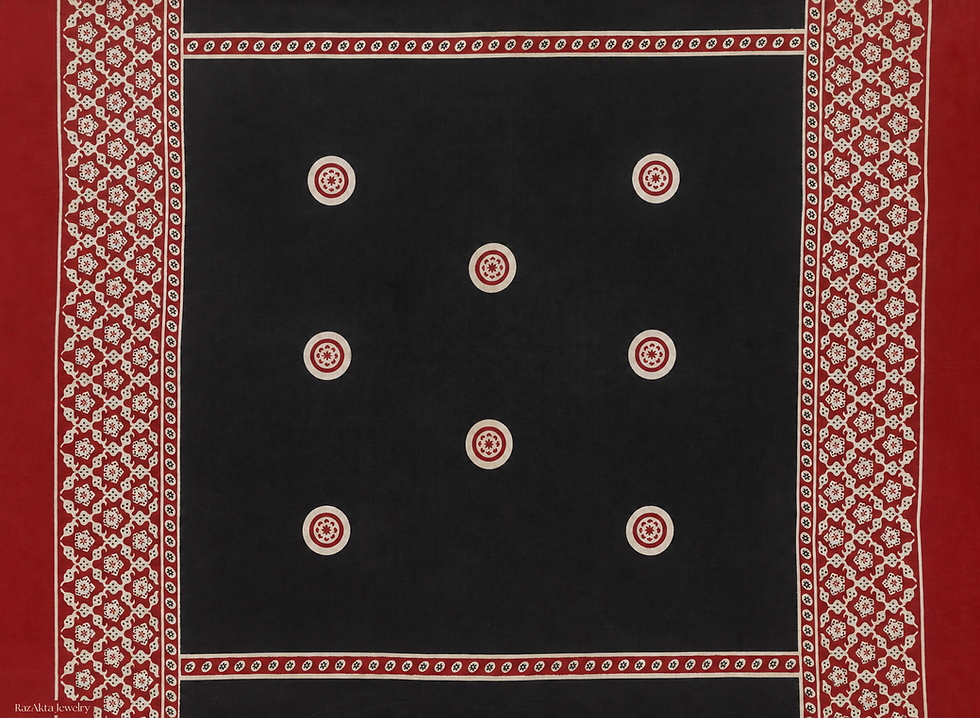
The Lahfe from Sana’a was made from cotton that began as a natural white. Its distinctive design was produced through a reverse woodblock-printing process, first in red and then in black.

A black square occupied the center. Across it were eight large red-and-white circles, placed symmetrically and described as resembling stars in a night sky. A narrow border of smaller circles surrounded the central field, with a flower or star in the center of each one. Along the shorter edges was a wider lattice of symmetrically arranged floral motifs, again printed in red and the natural white of the cloth.
A version worn by older women replaced the round forms with oval ones. It was humorously called the “cross-eyed Lahfe,” Lahfe Hawla (לחפה חוולא).
The Lahfe (לחפה) and the Makrama (מקרמה)

Another distinction I encountered was be
tween the urban Lahfe (לחפה) and the rural Makrama or Miqrama (מקרמה). This is a helpful starting point, but Yemenite Jewish clothing varied greatly between regions, and it should not be turned into one universal city-versus-village rule.
A study of Jewish communities in South Yemen describes women and girls in the region between al-Bayda and Habban covering their heads outdoors with a large rectangular cloth called a Miqrama. Unlike the Lahfe, as it was used in Sana’a, this cloth did not generally veil the face. Other regions followed still other systems of dress.
What remains of the Lahfe
After the community’s migration to Israel, the Lahfe gradually left the world of daily
street dress. Surviving examples are now encountered mainly in family collections, museum holdings, heritage displays, and reconstruction projects. Removed from the daily movement between the home and the street, it can easily appear to be only a patterned square of cloth.
For me, preserving an object also means being precise about what is known and what remains uncertain. The Lahfe (לחפה) was worn by the Jewish women of Sana’a and became part of their distinctive public appearance. Its cloth was imported from India and later from Italy. Whether the characteristic scarves were printed or completed in Yemen, and exactly when the Italian supply began, are still open questions.
Many details of its journey have been lost, but the Lahfe still carries the memory of the women who lived with it.
Sources
Ester Muchawsky-Schnapper, “Scarf, ‘Lahfe’” (צעיף, “לחפה”), Yemenite Jewish Heritage Center. The text is drawn from The Yemenites: Two Thousand Years of Jewish Culture, Israel Museum, Jerusalem, 2000, pp. 90–91.
Yosef Qafih (יוסף קאפח), Halikhot Teman: The Life of the Jews of Sana’a and Its Surroundings (הליכות תימן: חיי היהודים בצנעא ובנותיה), pp. 187–188. See the bibliographic record and an online excerpt discussing the three head coverings.
Yosef Yuval Tobi and Aharon Gaimani, eds., Yemenite Jewry: Identity and Heritage, Ben-Zvi Institute, 2019. The sample chapter describes the Miqrama and the regional dress of South Yemenite Jewish women.
Avshalom Mizrahi, “The Jewish Woman of Yemen” (בת תימן היהודייה), CET History Network, on head covering from childhood and differences between urban and rural women.
Israel Museum, The Yemenites: Two Thousand Years of Jewish Culture, exhibition record, 2000.
Carmella Abdar (כרמלה אבדר), ed., Ma’ase Rokem: Dress and Jewelry in the Tradition of the Jews of Yemen (מעשה רוקם: הלבוש והתכשיט במסורת יהודי תימן), E’ele BeTamar (עמותת אעלה בתמר), Tel Aviv, 2008.
Image sources
Raz Akta, Lahfe.
Boris Carmi, “Dancers of the Inbal Dance Theater” (רקדניות בלהקת "ענבל"). Meitar Collection, The Pritzker Family National Photography Collection, The National Library of Israel.
Unknown source, Sana’a.
Raz Akta, Lahfe detail.
Makrama fabric. האגודה לטיפוח חברה ותרבות – מורשת יהודי תימן.


Comments