What is Yemenite Jewelry? An Introduction
Updated: Sep 1
An exploration of history, tradition, and craft
So what is Yemenite jewelry? A lot of people ask me this. But to be honest, there isn't really a short answer. Yemenite jewelry isn’t just one style or one tradition. It’s a deep, complex world shaped by generations of Jewish artisans and rooted in ritual, protection, beauty, and survival.
This introduction looks at its historical roots, the materials and tools used to make it, the spiritual roles it played, and the ways in which it lives on today.

Roots and History: A Jewish Craft
Yemenite silversmithing was one of many Jewish crafts in Yemen, alongside embroidery, pottery, and basket weaving. Among these, jewelry stood out: it was almost exclusively the domain of Jews. For centuries, Yemenite Jews created intricate silver jewelry not only for their own communities, but also for surrounding Muslim families. The knowledge passed strictly from father to son, forming long family lineages of silversmiths who held both skill and spiritual responsibility.
In some parts of Yemen, Jews were restricted from working with gold, considered a noble metal under Islamic law. Even where it was allowed, many silversmiths avoided it due to its association with the Egel HaZahav (the Golden Calf), a symbol of sin in the Tanach. Thus silver, seen as modest and pure, became their primary material. There were instances, however, particularly in Sana'a, of Jewish artisans plating ornamental silver pieces in gold. These pieces were commonly used for ceremonial clothing.
In cities like Sana’a, Dhamar, Rada’a, Shar’ab, and Sa’ada, entire families and neighborhoods became known for their silverwork. Their pieces often included engraved inscriptions from the Tanach, chosen based on the owner’s spiritual need. Some inscriptions were visible on the surface, while others were hidden inside a hirz (amulet case), written on parchment and rolled up within the piece itself. Jewelry was not just worn for aesthetic reasons; it was protection, prayer, and identity.
Materials and Techniques
The base material in most traditional Yemenite jewelry is silver, often sourced from melted-down Maria Theresa Thalers. These coins, originally minted in the Holy Roman Empire in Central Europe, made their way to the Middle East in large quantities through trade. Over time, they became the primary accepted currency for commerce in the Red Sea region, including in Yemen. The silver from these thalers was preferred by Yemenite silversmiths not only for its availability, but also for its consistent purity of 83.3%, which became a regional standard and is the alloy found in most traditional Yemenite pieces.
The use of these thalers helped ensure consistency. If a piece cost five coins, a woman might pay two for the silversmith’s labor, and the remaining three would be melted down to create the piece itself. In this way, the coin was both the payment and the material.
Artisans used simple tools: drawplates, blowpipes, small anvils, saws, and shears. There were no lathes or motors, only patience and mastery. Every piece was made by hand, often at home.


Core Techniques Included:
Filigree (Shabk): Delicate silver wires twisted into lace-like openwork.
Granulation (Zir’a): Tiny silver balls, arranged in precise patterns.
Repoussé (Naksh): Hammering the front and back to create raised reliefs.
Punching (Damga): Decorating silver wires with texture.
In Sana’a, the most refined pieces often used hollow filigree, with open designs and no plate backing. Some pieces were even plated in gold, particularly those meant to be sewn onto clothing. In every region, each detail was done by eye, without molds, shortcuts, or an instruction manual.
The Role of Beads and Elements
Jewelry was more than metal. Many pieces were threaded with coral, amber, onyx, carnelian, or cowrie shells, each believed to hold its own healing or protective force.
Coral (Marjan) guarded against the evil eye and infertility
Amber (Kahrab) brought warmth and balance
Onyx (Jeza) helped with clarity and insight
Carnelian (Aqiq) supported energy and courage
Cowrie Shells (Wadda’) absorbed negative energy
One of the most iconic components was the Tuta bead (Arabic for "berry"), a small silver sphere made from granules soldered together. These beads were not perfectly round or smooth. They were dense, irregular, and full of meaning. Strands of coral and Tuta beads were often made for brides, newborns, and those in spiritually vulnerable stages of life.
Just like in traditional henna or embroidery patterns, many of the motifs found in jewelry come from nature: fish, flowers, grains, the sun, and the moon, all symbols of fertility, abundance, and continuity.
Ritual and Protective Uses

In Yemenite Jewish culture, jewelry was a form of protection. It was tied to identity, belief, and spiritual health.
Women wore jewelry during major life events, like marriage, childbirth, or mourning. Pieces were sewn to the gargush (a ceremonial head covering), the antari (a long robe), and even to tirgul or mihrar (types of traditional trousers), especially the ankles, waistband, and neckline, which were seen as spiritually vulnerable areas of the body.
Jewelry marked the stages of life. Infants were wrapped with strands of beads. Children wore specific pieces suitable for their age, which would later be replaced as they entered adulthood, and again after marriage. In older age, jewelry might be adapted or replaced to reflect changes in status, health, or role in the family. What someone wore told a story about who they were and what stage of life they were in.
Brides would be adorned head to toe. In times of hardship or sickness, people would commission amulets inscribed with blessings, sealed in silver, and worn close to the body. Each item was personalized, crafted for a specific person, problem, or phase of life.
Regional Styles and Family Traditions
Every region in Yemen had its own distinct aesthetic and production methods. Some styles were known for their refinement, others for their size or symbolism. These differences reflected geography, resources, and the traditions passed down in each community.

Sana’a (Central Yemen): Highly detailed filigree, smaller wires, hollow designs, and gold-plated elements sewn onto garments.
Sa’ada (Northern Yemen): Large silver forms, minimal filigree, and broad empty surfaces, known for bold, heavy jewelry.
Ta’izz (Southern Yemen): Regional influences blended with local tastes; lighter, wearable styles and a stronger focus on detailed granulation.
Habban and Hadramaut (Eastern Yemen): Triangle-plate necklaces, tight chokers layered with heavy strands. Women sometimes wore nose rings and as many as 14 earrings in a single ear.
Two styles of jewelry became prevalent in Sana’a and its surrounding regions. These were bawsani, known for its extensive use of filigree, and badihi, known for its tendency toward granulation. Both were named after two prominent Jewish silversmiths.
Jewelry as Family Wealth
In Yemen, silver jewelry belonged to the women. It was how families stored wealth. In difficult times, a woman might sell a piece, or even a single bead, to help her household survive. Once stability returned, she would buy it back or commission a replacement. Jewelry was wealth, but also inheritance, responsibility, and memory.
Continuity and Today’s Makers
When most of Yemen’s Jews left during Operation Magic Carpet (1949–50), many silversmiths lost their homes, tools, and materials. In Israel, survival took priority. Silversmiths found work in factories, and sons stopped learning from fathers. The jewelry’s original spiritual, protective, and personal purposes began to disappear.
Today, only a few artisans preserve the old ways. Traditional silversmithing is almost extinct. But in certain hands, it lives on, not as a replica, but as a living tradition.
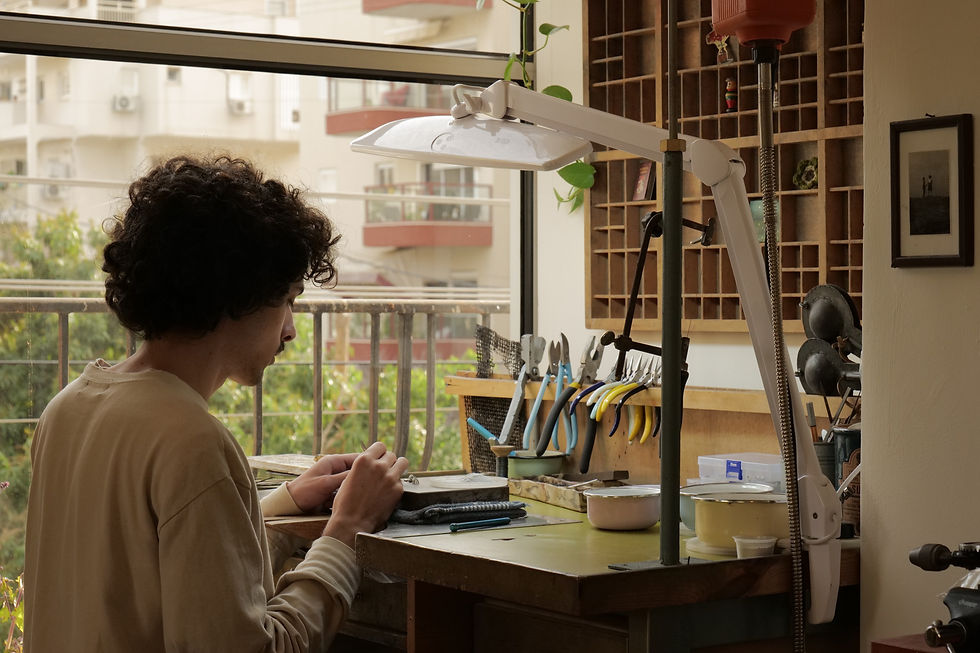
At Raz Akta Jewelry, each piece is made by hand with respect for the silversmiths who came before. I work with traditional techniques and elements, carrying this knowledge into pieces made for the present.
Sources and Acknowledgments
This article draws on historical and ethnographic material from:
Carmela Abdar, Ma’ase Rokem (2008), Heb.: מעשה רוקם
Marjorie Ransom, Silver Treasures from the Land of Sheba (2014)
Moshe Oved, The Jews of Yemen (2013), Heb.: הסיפור המופלא של יהדות תימן
Ora Berger, The Jewellery of the Jewish Bride in San’a as a Cultural and Artistic Message: 18th Century (2005)
Zohar Amar, HaChen SheBaEven (2017), Heb.: החן שבאבן
Personal communication: Oral histories and lived experiences of Yemenite Jewish families
Image credits, in order:
Zoltan Kluger (1946). A Yemenite Habbani woman wearing her traditional clothes and jewelry.
Boris Karmi, The Pritzker Family National Photography Collection, The National Library of Israel (1964). Yemenite silversmith working in Moshav Bareket.
Boris Karmi, The Pritzker Family National Photography Collection, The National Library of Israel (1964). Yemenite silversmithing tools.
Yehiel Haibi, The Israel Museum Collection (1930-40). Yemenite Jewish girl wearing a headdress (gargush), necklaces (kashah and lazem), and bracelets (sabah).
Detail from a necklace (gumak/mazamir), typical of the Rada'a region and in the north. Pinterest
Raz Akta (2025). Raz Akta making Yemenite jewelry.


Please, add to the bibliography: Ester Muchawsky-Schnapper, The Yemenites. Two Thousand Years of Jewish Culture, Jerusalem 2000.